
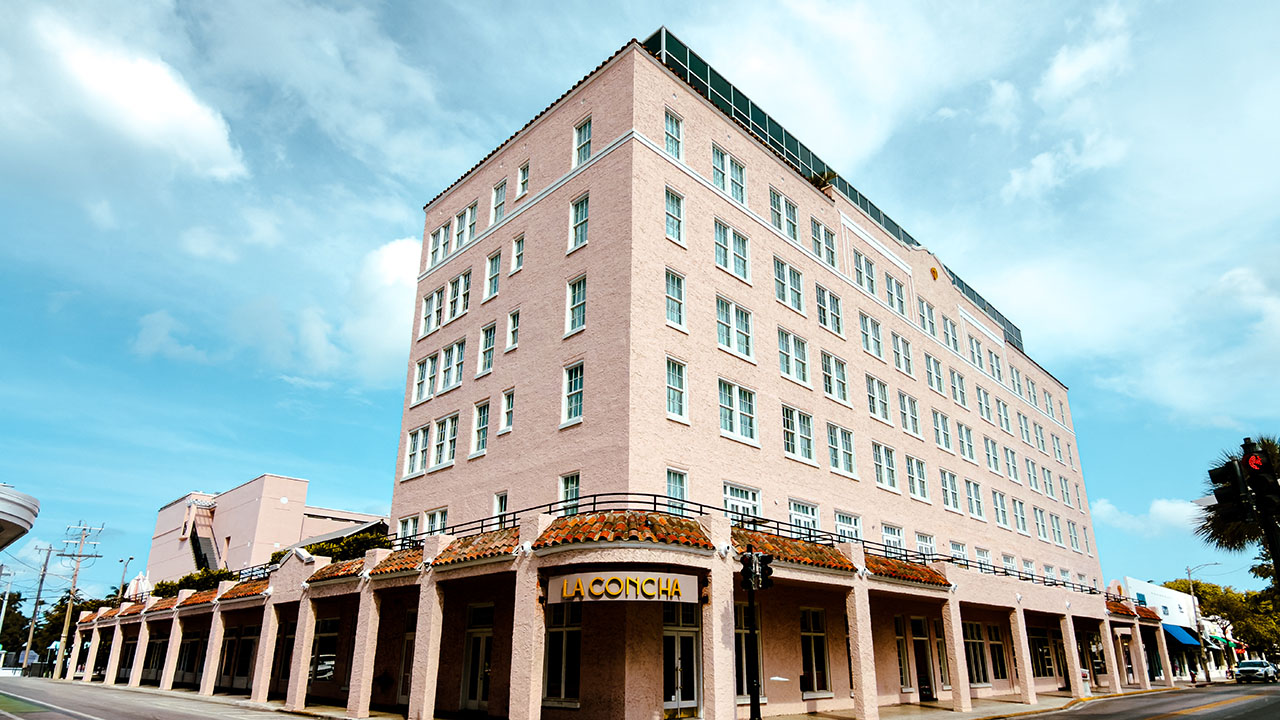
La Concha Hotel, Key West, Florida – By Nika Stroble Photography
Every island needs a landmark — a fixed point against which everything else is measured. In Key West, that point has stood at the center of Duval Street for a hundred years. Rise above the rooftops of Old Town and look toward the heart of the island, and there she is: seven stories of pale stucco, taller than anything around her, presiding over the town with the calm of a grande dame who has seen it all and kept her composure throughout. Sailors once used her to find the harbor. Residents still use her to find their way home on a long evening’s walk.
She is La Concha, and her story is, in many ways, the story of the island itself.
She was born of a railroad and an ambition. When Henry Flagler extended his Florida East Coast Railway down the chain of islands to Key West, he connected a once sea-bound city to the mainland and, almost overnight, transformed it into a destination. Among those who saw what the island might become were the real estate visionary Carl Aubuchon and Jefferson B. Browne, who set out to give Key West its first true luxury hotel. They spared nothing. When La Concha opened her doors in 1926, she was modern and, in the language of the day, fireproof — built on steel for permanence, finished in marble, fitted with private baths and one of the island’s earliest electric elevators. From her rooftop, guests took in a view of the island available from no other vantage. A room cost three dollars; a steak dinner could be added for thirty-five cents. She was a sensation from her first morning.
What has made her endure, though, is not her grandeur but her company. Within these walls, Hemingway is said to have worked on To Have and Have Not. Tennessee Williams completed A Streetcar Named Desire here. Harry Truman, who kept his Little White House on the island, knew her halls. For a century she has been the place where the literary, political, and social currents of Key West converged — a rooftop above a town of cigar makers and dockworkers, writers and dreamers and the occasional rogue. Her hundred years have held hardship, too: the crash of 1929 turned one of the nation’s richest cities into one of its poorest within months, and a great hurricane followed soon after. But La Concha did what the island always does. She endured, recovered, and reclaimed her place. A recent restoration has renewed her grandeur for a new era while leaving her essential character intact, and she remains, to this day, the tallest building in Key West — still pointing the way home.
For those of us who represent the homes of Old Town, La Concha is more than a hotel. She is a reference point, in every sense. The neighborhoods gathered at her feet hold some of the most coveted historic residences on the island — the conch cottages and shotgun houses, the deep porches and the grand façades, the homes that have watched the same skyline rise and weather the same storms she has. Their value is inseparable from this sense of place, from the knowledge that here you do not live at the edge of the island’s history. You live inside it.
That is the intelligence we bring to every home we represent: not merely what it is worth today, but where it sits in the long, layered story of the island — a story La Concha has watched over for a century, and will watch over for the next. To own a home in her shadow is to belong to something that endures. On an island defined by the sea’s constant motion, there is a rare luxury in that kind of permanence.