
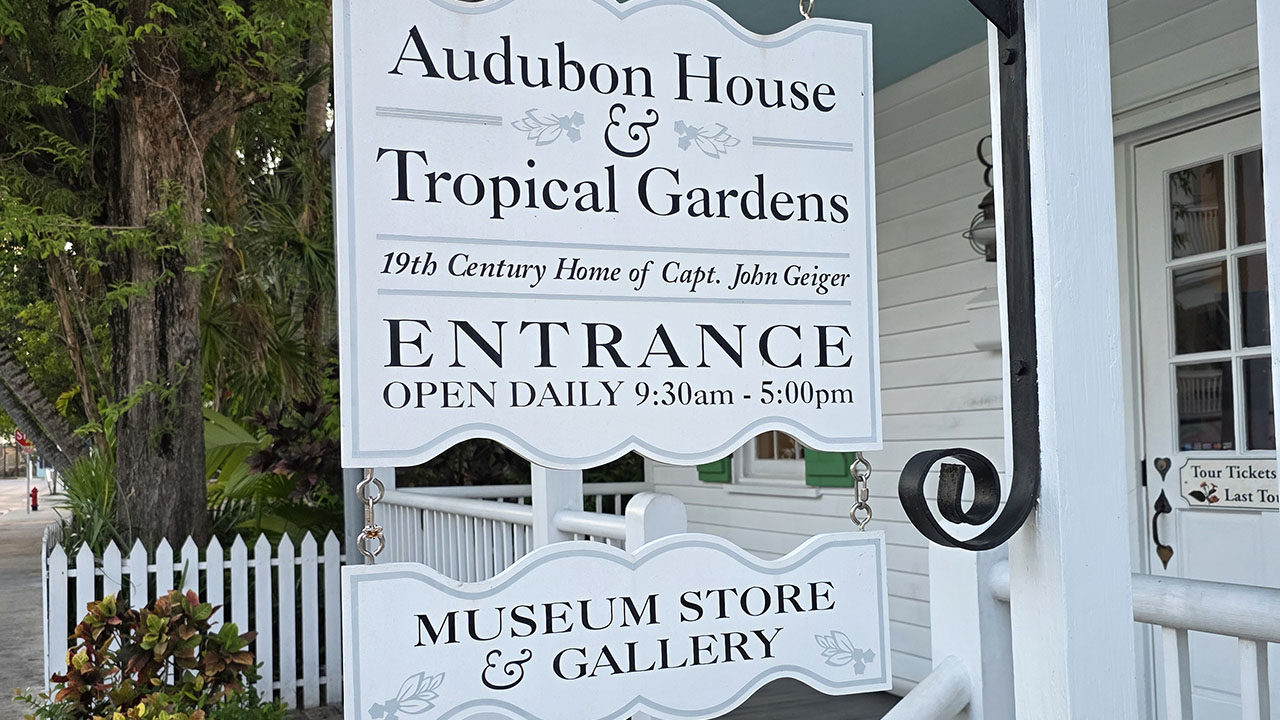
The Audubon House and Tropical Gardens – Photo by Marci Bracco
The House That Saved Old Town: Inside Audubon House and Tropical Gardens
Most people walk past it. The white picket fence, the deep porch, the hand-painted sign swinging from a wrought-iron bracket at the corner of Whitehead and Greene — it reads like one more pretty facade on a street full of them. It is not. Behind that fence sits the house that changed the course of Key West, the one that turned a demolition list into a preservation movement and gave Old Town the shape it still has today.
If you own a historic home on this island, or hope to, this is the house that made it possible.
A Wrecker’s Mansion at Whitehead and Greene
In October 1846, a hurricane tore through Key West and damaged or destroyed nearly every home on the island. In the aftermath, Capt. John Huling Geiger — a harbor pilot and master wrecker, and one of the wealthiest men in town — started building. Construction ran from 1846 to 1849.
Geiger chose his corner deliberately. Whitehead and Greene put the house in full view of everyone coming and going from the waterfront, which was exactly the point. He hired the island’s best carpenters and spent on the best materials: a frame and floors of Dade County pine, cypress exterior doors, a mahogany staircase, the whole structure joined with mortise and tenon. The style was American Classic Revival, and a cupola at the roofline — long since gone — gave him an unobstructed view of the sea. For a wrecker whose living depended on being first to a ship in trouble, that view was not decoration. It was the business.
The Recluse, the Gas Station, and the Rescue
Four generations of Geigers lived in the house for close to 110 years. The last was the captain’s great-grandson, Capt. William Bradford Smith, a recluse who spent more than two decades there alone with no electricity, no running water, and no indoor kitchen. By his death in 1956, the windows were shuttered and nailed shut and the house was falling in on itself.
In 1958 it was slated for demolition to make room for a gas station. A local resident named Jessie Porter got word to Mitchell and Frances Wolfson, a family with Key West roots going back to the 1870s and a goods store on Duval. The Wolfsons bought it. Two years of restoration followed — electricity included — and the Audubon House Museum opened in 1960.
That single rescue is the hinge point. It was the first large-scale restoration on the island, and it proved that these houses were worth saving. The Historic Old Town district grew directly out of that decision. The Mitchell Wolfson Family Foundation still cares for the property.
The Audubon Connection, Straightened Out
The name confuses people, and reasonably so. John James Audubon visited Key West in 1832 — fourteen years before this house existed. So how does his name end up on the door?
The answer is the land, not the building. Audubon arrived with a letter of introduction to Dr. Benjamin Strobel, whose house stood on this same property, then owned by island founder Pardon Greene. Several families lived on the lot, the Geigers among them, and at its center was a garden of native and imported tropical plants. Audubon used those plants as the settings for his images of local birds — his white-crowned pigeon is perched in the branches of a geiger tree from this very yard. Twenty-two of the 435 original Havell plates in “The Birds of America” show birds he observed and painted in Florida in 1831 and 1832.
Local folklore about that connection is part of what persuaded the Wolfsons to save the house in the first place. The museum they opened commemorates the 1832 visit and shows Audubon’s work inside the Geiger family’s rooms.
What the House Still Teaches Us
Walk the rooms and you are looking at the reason so many Old Town homes are still standing. Dade County pine is dense enough to turn a nail and resists rot and termites in a climate that punishes both — which is why a house built in the 1840s outlasted the neglect of the 1950s. Mortise-and-tenon joinery flexes rather than shears in a storm. The separate cook house kept fire and heat away from the living quarters. Deep porches and tall shuttered windows moved air before anyone had a compressor to do it for them.
None of that was styling. It was people building for the place they actually lived in, and it is the same logic behind every well-restored home on this island today. When we walk a client through a historic property, these are the details we are reading: the floors, the joinery, the roofline, what has been kept and what has been quietly replaced. A house that has been cared for tells you so, and one that has not tells you that too.
Buying a historic home in Old Town is a form of stewardship. You are not the first person to hold it and you will not be the last. The Wolfsons understood that in 1958, and everyone who has restored a Conch house since has been working in the space that decision opened up.
Planning Your Visit
Location: 205 Whitehead St., at the corner of Greene Street, a short walk from Mallory Square and the Historic Seaport.
Hours: the house is open daily, 9:30 a.m. to 4:15 p.m.; the gallery and gift shop stay open until 5 p.m. Confirm current hours at audubonhouse.org before you go.
Timing: allow 60 to 90 minutes to see the house and the gardens without rushing.
Pair it with: the Custom House across the street, the Historic Seaport a few blocks north, and sunset at Mallory Square to close out the afternoon.
Best moment: mid-morning on a weekday, when the garden is shaded and nearly empty. Set aside more time out there than you think you need — it is one of the quietest places on the island, and the sound of Duval simply stops at the fence line.
Frequently Asked Questions
Q: Did John James Audubon live in the Audubon House?
A: No. Audubon visited Key West in 1832 and spent time on this property, which then held several homes and a large tropical garden. The house standing today was built by Capt. John Huling Geiger between 1846 and 1849, after Audubon’s visit. The museum takes its name from the artist’s documented connection to the grounds.
Q: What makes Audubon House important to Key West?
A: It was the first large-scale historic restoration on the island. Saved from demolition in 1958 by Mitchell and Frances Wolfson and opened as a museum in 1960, it sparked the preservation movement that produced the Historic Old Town district we know today.
Q: What is Dade County pine, and why does it matter in a Key West home?
A: Dade County pine is old-growth heart pine harvested from South Florida, so dense with resin that it resists rot and termites and is famously hard to nail. It was the framing and flooring material of choice in 19th-century Key West, and it is a large part of why so many houses from that era are still standing. In a historic home today it is a mark of original construction and worth preserving carefully — the old-growth timber it came from is gone.
Q: How long does a visit to Audubon House and Tropical Gardens take?
A: Plan on 60 to 90 minutes. A guide introduces the property and its history, then you tour the house, the gallery, the replica cook house, and close to an acre of tropical gardens at your own pace.
Q: What are the hours at Audubon House?
A: The house is open daily from 9:30 a.m. to 4:15 p.m., with the gallery and gift shop open until 5 p.m. Hours can change seasonally, so check audubonhouse.org before your visit.
Brenda Donnelly Real Estate has spent more than two decades representing the historic homes of Key West — the ones with the pine floors, the eyebrow rooflines, and the stories underneath. If you are considering a move on this island, in either direction, we would be glad to walk you through what to look for.
1119 White Street, Key West, FL 33040 • 305.304.1116 • brendadonnelly.com